
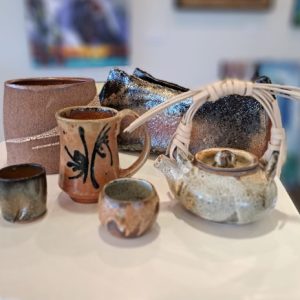
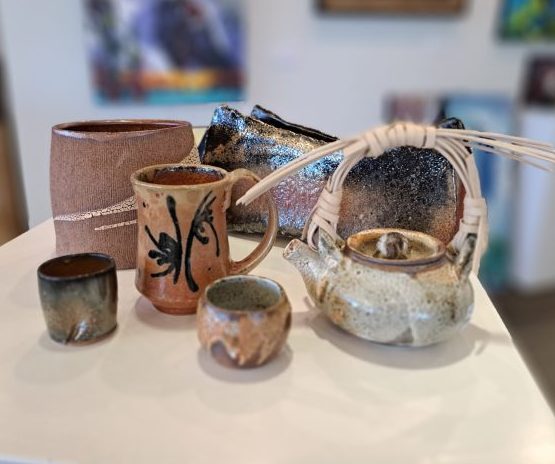
I work primarily in Shino glazes, reduction firing in a gas kiln.
Shinos are reactive in atmospheric firings; as the flame looks for
oxygen, it will pull it out of the piece, pulling out soda ash, and
trapping carbon and changing the colors /textures of a piece. It
is totally random and one of a kind (moreso than any other
firings), and dependent on the clay used, how the kiln is packed,
the weather, the shape of the form, how the piece is glazed, the
chemicals used and many variables, mostly unknown,
..sometimes how I hold my head helps, I am sure!
Shino is considered one of the oldest, if not the oldest glaze known.It has a long and harried history. Originally developed in Korea, it made its way to Japan where it took on a life of its own. It was significant in the relationship of the Samurai, who used "shino" teabowls as they went into meditation before going out to war. The original Shino was heavily laden with "chunks" of feldspar and other materials. Shino made its way to the States, where a grad student, Virginai Wirt, working with Malcom Davis (a minister turned potter) revised the glaze and it transformed into what it is today. It is coined "American Shino", but the most widely used Shino glazes are "Malcolm Shinos".
Shino is know for its variance in colors... heavy reduction, (reduction is the act of closing off the air at a certain point in the 26 hour firing) where a piece can be kissed by black, or if in a hot spot of the kiln, leaving a piece all black. Colors vary from whites, pinks, soft peach, variations of oranges, greys, greens, reds...I have even had blues . it is exciting to see the path of the flame on a piece as the flame leaves it mark on the pot.
Excitement, magic, and fallen heart are experienced with EVERY kiln opening. They can be gnarly, crawl, dry, shiny, and everything and anything in between. Working with Shino is both unexpected and exciting and challenging. IT does require one to form a relationship with it to understand it and then it will serve you well...as well as can be expected! Pieces will be related, but never identical. It is part of the culture of incorporating the movement of nature into a piece..One of a kind is the pursuit. Firing Shino is one of THE most challenging experiences of my Clay Artist life.
I am influenced by the Alberta rockies which show the colorations and markings often found on Shino pots. There is a wall at Athabasca Falls, in Jasper that has been my inspiration. It is a beautiful example of the Shino colorations and textures. I appreciate "simple" forms that share a relationship with the glaze, the firing, both Art and Function. It is my desire to encourage individuals to choose pieces that call to them....choosing handmade pieces that have the same feel as one's favorite shoes or favorite jeans, act to elevate one's day. Shinos call to people. Rarely can an individual have just one. They are called "the hundred year pots" as it is said that an individual can study a piece for a hundred years, and see /feel something new in that time. It is no wonder why they are soo highly treasured over the centuries.
Shino is considered one of the oldest, if not the oldest glaze known.It has a long and harried history. Originally developed in Korea, it made its way to Japan where it took on a life of its own. It was significant in the relationship of the Samurai, who used "shino" teabowls as they went into meditation before going out to war. The original Shino was heavily laden with "chunks" of feldspar and other materials. Shino made its way to the States, where a grad student, Virginai Wirt, working with Malcom Davis (a minister turned potter) revised the glaze and it transformed into what it is today. It is coined "American Shino", but the most widely used Shino glazes are "Malcolm Shinos".
Shino is know for its variance in colors... heavy reduction, (reduction is the act of closing off the air at a certain point in the 26 hour firing) where a piece can be kissed by black, or if in a hot spot of the kiln, leaving a piece all black. Colors vary from whites, pinks, soft peach, variations of oranges, greys, greens, reds...I have even had blues . it is exciting to see the path of the flame on a piece as the flame leaves it mark on the pot.
Excitement, magic, and fallen heart are experienced with EVERY kiln opening. They can be gnarly, crawl, dry, shiny, and everything and anything in between. Working with Shino is both unexpected and exciting and challenging. IT does require one to form a relationship with it to understand it and then it will serve you well...as well as can be expected! Pieces will be related, but never identical. It is part of the culture of incorporating the movement of nature into a piece..One of a kind is the pursuit. Firing Shino is one of THE most challenging experiences of my Clay Artist life.
I am influenced by the Alberta rockies which show the colorations and markings often found on Shino pots. There is a wall at Athabasca Falls, in Jasper that has been my inspiration. It is a beautiful example of the Shino colorations and textures. I appreciate "simple" forms that share a relationship with the glaze, the firing, both Art and Function. It is my desire to encourage individuals to choose pieces that call to them....choosing handmade pieces that have the same feel as one's favorite shoes or favorite jeans, act to elevate one's day. Shinos call to people. Rarely can an individual have just one. They are called "the hundred year pots" as it is said that an individual can study a piece for a hundred years, and see /feel something new in that time. It is no wonder why they are soo highly treasured over the centuries.
Artwork by Ruby Serben
Interested in showcasing your work at Grant Berg Gallery?
We are actively seeking Indigenous Artists to be featured at our gallery. All inquiries can be submitted online by clicking the button below.
Learn More